

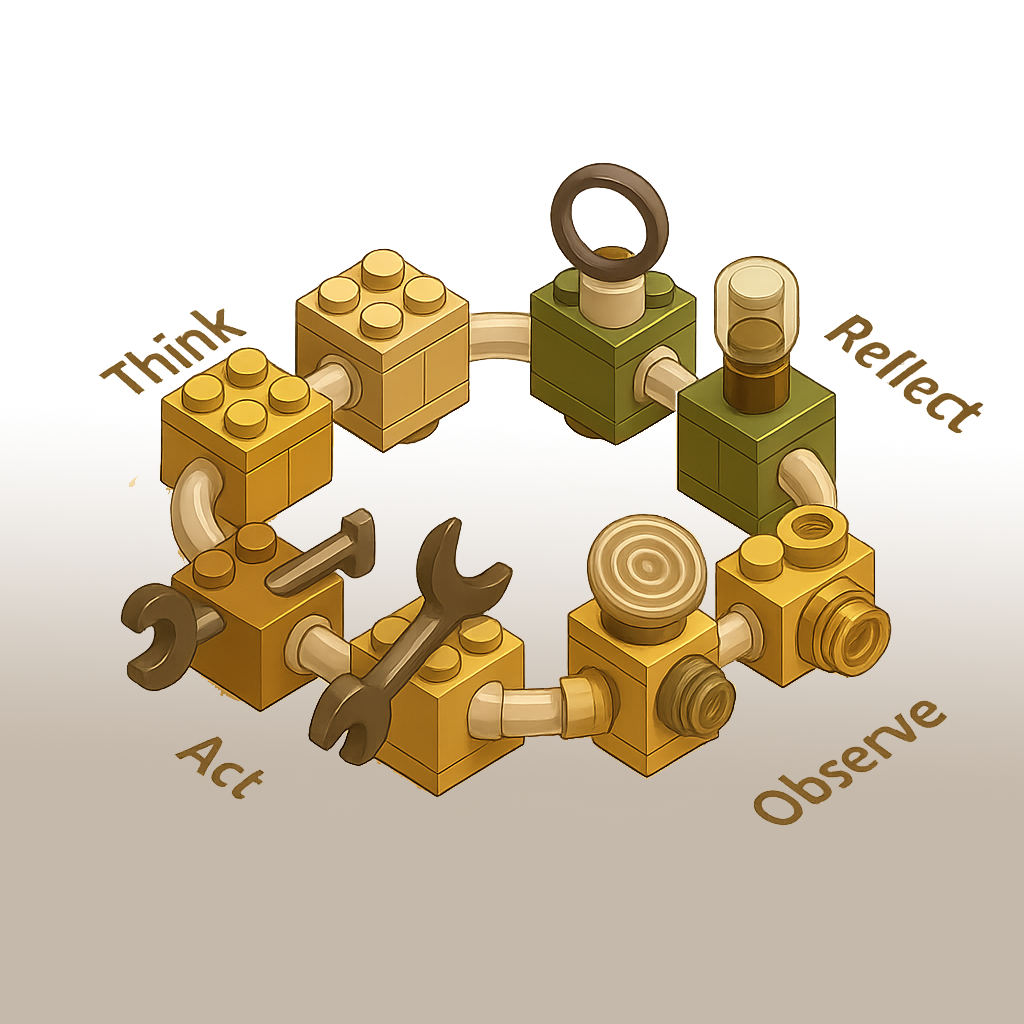
ReAct Framework
Reasoning and Acting for Intelligent Decision Systems
A breakthrough approach to AI agent architecture that explicitly integrates reasoning steps with action execution, creating more reliable, explainable, and effective AI systems.
Implement a "think before you act" paradigm that produces transparent, trustworthy AI systems by ensuring every action is preceded by deliberate reasoning processes.
Pattern Overview
The ReAct Framework represents a breakthrough approach to AI agent architecture that explicitly integrates reasoning steps with action execution. This pattern creates more reliable, explainable, and effective AI systems by ensuring that every action is preceded by a deliberate reasoning process that grounds decisions in explicit logic.
At its core, ReAct implements a cyclic process of observation, reasoning, planning, and action that mirrors human cognitive processes. Unlike traditional stimulus-response systems, ReAct agents maintain internal reasoning chains that connect observations to actions through traceable logic steps.
Key Components
- Observation Module: Captures and structures input from the environment
- Reasoning Engine: Applies logical inference, causal reasoning, and knowledge retrieval
- Planning Mechanism: Formulates potential action sequences and evaluates outcomes
- Action Selection: Chooses optimal actions based on reasoning outputs
- Execution Module: Implements selected actions and captures feedback
Explicit Reasoning Steps
What distinguishes ReAct from other agent architectures is its insertion of deliberate reasoning stages between observation and action, creating a "think before you act" paradigm.
- Decision Transparency: Every action is linked to explicit reasoning steps
- Error Reduction: Flawed reasoning can be detected before actions occur
- Regulatory Compliance: Decision trails satisfy explainability requirements
- Continuous Refinement: Reasoning patterns can be audited and improved
Technical Architecture
System Components
1. Observation Processing
- • Multi-modal input handling (text, image, structured data)
- • Context aggregation and relevance filtering
- • Observation structuring and normalization
2. Reasoning Engine
- • Chain-of-thought reasoning mechanisms
- • Knowledge retrieval and integration
- • Hypothesis generation and evaluation
3. Planning System
- • Goal decomposition into achievable steps
- • Action sequence generation
- • Outcome simulation and evaluation
Implementation Stack
Infrastructure
High-performance inference environment for reasoning models with vector databases
Development Framework
Structured workflow with traceable reasoning steps and comprehensive logging
Monitoring
Complete logging of reasoning chains and decision processes with audit trails
Google Cloud Components
- • Vertex AI for model serving with performance optimization
- • BigQuery for data analysis and knowledge extraction
- • Document AI for unstructured data processing
- • Workflows for orchestrating reasoning-action sequences
Industry Applications
BFSI
- • Fraud detection with explicit justification
- • Credit underwriting with transparent reasoning
- • Investment analysis with multi-factor reasoning
Manufacturing
- • Quality control with defect analysis
- • Process optimization with reasoning chains
- • Maintenance planning with failure analysis
Healthcare
- • Diagnostic support with transparent reasoning
- • Treatment planning with multi-factor analysis
- • Drug interaction analysis with causal reasoning
Retail/eCommerce
- • Product recommendations with transparent logic
- • Pricing strategies with multi-factor reasoning
- • Customer service with problem diagnosis
Advantages & Limitations
Key Benefits
- Explainability: Every decision includes a traceable reasoning chain
- Reliability: Reduced "hallucination" through constrained reasoning processes
- Adaptability: Reasoning components can be specialized for different domains
- Trustworthiness: Human-verifiable logic increases stakeholder confidence
- Regulatory Alignment: Satisfies growing requirements for AI transparency
Challenges & Mitigations
Reasoning Latency
Tiered reasoning depth based on decision criticality
Knowledge Gaps
Comprehensive knowledge bases with fallback mechanisms
Performance Overhead
Caching common reasoning patterns and outcomes
Integration Complexity
Standardized interfaces between reasoning and action components
Implementation Roadmap
Phase 1: Foundation
1-2 months
- • Establish knowledge bases and reasoning patterns
- • Implement core reasoning components
- • Develop initial action execution framework
Phase 2: Initial Implementation
2-3 months
- • Deploy first reasoning-action cycles
- • Implement monitoring and validation frameworks
- • Collect feedback for reasoning refinement
Phase 3: Expansion
3+ months
- • Extend to additional domains and decision types
- • Optimize performance and resource utilization
- • Implement advanced governance controls
Phase 4: Enterprise Scale
Ongoing
- • Establish comprehensive governance framework
- • Develop reusable reasoning patterns library
- • Implement advanced knowledge integration